
Rules for life
... and llamas to the rescue!
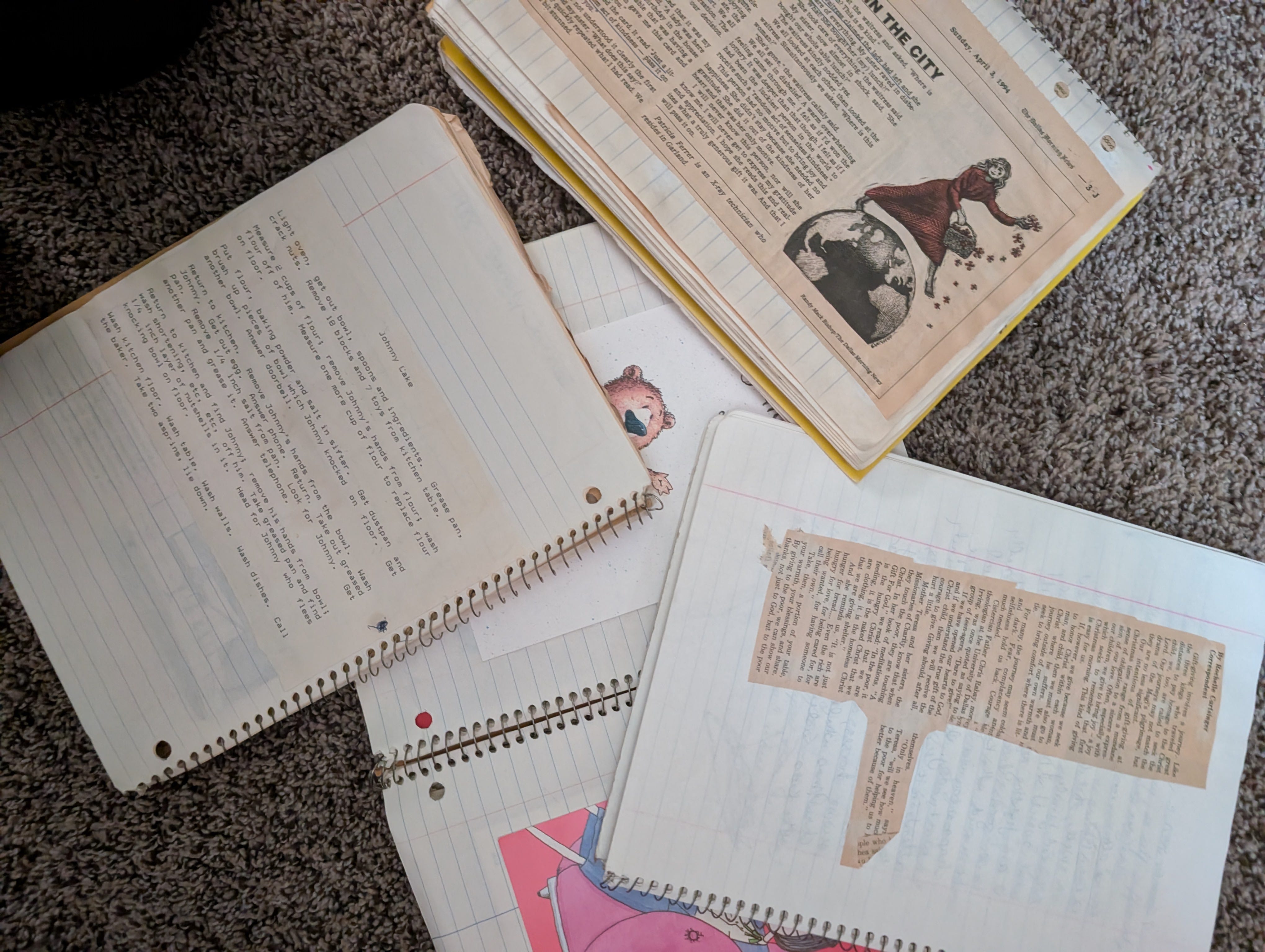
Three decades ago, in the thick of my years as Momma to our four kiddos, I cut out articles from newspapers1 that I found interesting and glued them into spiral notebooks. These college-ruled wonders also contained scribbles of life advice, memorable adages, quotes from books I’d read, cartoons, mementos from my children, and entries about our family life or cultural moments. News about random acts of kindness or recent elections nestle next to notes about first words and first steps. It was part note-taking, part scrap-booking, and part journaling.
These books have lived on my office shelves for decades, pulled out when I’m feeling nostalgic or need to fact-check something one of my adult children mentions in passing. On their covers is scrawled Family Journal.
I recently discovered I mis-named them. Apparently, they should be labeled Commonplace Book, a renaissance-times practice that is enjoying a bit of a revival in our oh-so-digital times.
In its simplest form, a commonplace book is a place to record and organise all those quotes, stories, and ideas from other people so that you can recall them to inspire you in the future. (Millie Blackwell at Mrs. Blackwell’s Village Bookshop.)
People have been keeping commonplace books for eons, which I learned when reading Susie Dent’s excellent novel, Guilty by Definition. If you’re a word-nerd of any kind, I can’t recommend this book enough (blurb here). There’s intrigue, backstabbing, friendship, and heartbreak set amid the backdrop of lexicography and etymology. I especially enjoyed the definitions that open each chapter.
I mean, who doesn’t need to know this word: “Verschlimmbesserung: an attempted improvement that ends up making things worse.” If I were currently keeping a commonplace book, that definition would absolutely be going in my book. (Side note: I think a chunk of my approach to life, unfortunately, has been verschlimmbersserung. 🤦)
After finishing Dent’s book, I pulled out my family journals commonplace books and noticed a thread running through them — a Rules for Life kind of vibe. I suppose that’s to be expected, as so much of my life as an op-ed writer was offering up opinions about how life should be led. I’m certain I quoted some of the writers who found their way into my commonplace books.
Interestingly enough, in reviewing the advice for life throughout these books, I realize that most of of the life rules are still applicable, despite how much has changed since the 1990s. So, I’ve decided to share them here because — you never know — some of you readers might could use them!
Please know I’ve only been about 87.6% successful in following these rules, and I still fail at some — a call center run-around is my Achilles heel! But just because something is hard doesn’t mean it isn’t useful. In fact, the opposite is usually true, so here, for your consideration: 30 Rules for Life.
In any queue, send good thoughts/say a prayer for the person in front of you; it will keep impatience at bay.
Addendum for our digital world: Put down your phone and look around. Smile at strangers. Send those good thoughts. Keep an eye out for a bear running through the aisles.
Give people the benefit of the doubt. Sometimes the guy cutting you off in traffic is just a jerk. But maybe he’s rushing his wife to the hospital. Regardless, getting angry at other people adds nothing positive to your day.
Many hands make light work (aka: no one gets a break until everyone can have one). The entire family has responsibility for house/yard. Rotate daily and weekly chores so everyone learns how to clean a toilet, cook, mow the lawn, etc.
Give little ones space. They are often happy as clams cooing in their crib, playing with their blocks, scribbling with crayons, or building a fort and then a parent interrupts and tries to teach, entertain, or correct. Kids need space and to get comfortable with independent play. Plus: do you like being interrupted when you’re concentrating?
Pay attention to your body in public spaces. Are you blocking a door with your chair? Hogging the arm rests in a plane? Obstructing someone’s view of the stage? Walking down the middle of a parking lot and, ergo, impeding car traffic? (M honey’s pet peeve.)
When siblings are arguing, have them touch noses. Argument ended, laughing begun.
Make your lunch for tomorrow tonight. It will make your morning much less rushed.
Give allowances to teach “spend, save, share”, but don’t tie allowance to chores unless you want the battle of “I don’t want to do my chores; you can keep my allowance.”
Don’t do your child’s homework/help with school projects. Offer aid in figuring out steps, teach project management, research skills, how to print information off the internet, etc.. But otherwise, get out of the way. The only way to learn is to do. Make sure your child is the one doing.
Make your bed.
Ask, “How can I help?” when arriving to a family or friend event. Thirty minutes before you’re planning to leave, ask, “Is there something I can help with before I go?”
Let kids get bored. The sooner they learn how to handle boredom, the better able they’ll be to survive adulthood’s tedium. Plus, boredom is the precursor to creativity.
Write thank you notes.
Don’t bring flowers as a hostess gift. They have to be cared for the moment they are received and your host/hostess is already busy. (But I can bring them in a vase, you say? Yes… and does anyone need another vase?)
When in an argument, shift from blame to solution. Ask “What can we do to make this situation better?”
Teach laundry skills by age 8. Kids will be horrible at this in the beginning, but just keep teaching and they will master it. One less thing on Mom’s to-do list.
Return grocery carts to where they are supposed to go.
Be nice to people in customer service and call center jobs. Smile brightly, ask about their day, spread the love.
Make Sunday sacred. I’m big on everyone going to church (or, if you’re Jewish, observing Shabbat), but if you’re anti-organized religion, find some other way to make Sunday different than the rest of the week — quieter, more attentive, slower, more loving, simply more holy.
Be a good friend and you will — in general — make good friends. True, it sometimes doesn’t work and breaks your heart, but keep trying.
Learn to cook, and teach your family to cook with you. If you can — and everyone can — grow some food in your backyard.
If someone comes to mind, reach out to them.
If you have ADD/ADHD, write yourself notes and put them on your car’s dashboard, the front door, the door to the garage, and your bathroom mirror. Don’t trust that you’ll remember the note you added to your phone three hours (or three days) ago.
Take a deep breath and count to five before responding in any tense situation. Be the calm in the face of the storm.
Master the niceties of human connection: Smile, make eye contact, offer a handshake, say Nice to meet you and ask How are you. Teach your children the same and let them practice a lot so it becomes second nature.
Be interested in other people. Ask good questions and listen well. Make others the center of attention. Teach your kids this skill.
If you’re feeling left out, throw a party at your house.
Never pass up a hug. Hug as many people as much as life allows.
Be neighborly (here’s how). When the poop hits the fan, it isn’t the city council or state legislature or the president who will help in the first few days/weeks/months (thinking of the Lower 9th Ward after Katrina here) — it will be your neighbors.
There’s always something to be thankful for. Look for it.
Along the lines of looking for things to be thankful for, check out this story about llamas helping the police capture a criminal. Llamas: 1; Bad Guy: 0.
Thanks for reading. If you have other Rules for Life, please share in the comments so the hive mind can benefit. I’m always looking for better ways to live life.
If you’d enjoyed this post, please share it. If you want to get more of my work, subscribe (it’s free!) by clicking the orange button below, and if you want to support my work in a one-off paid way, just click that blue coffee button! Happy beginning of Lent to those observing the season, happy Ramadan to those celebrating that, and happy almost-weekend to everyone. :-)

Newspapers were things made out of paper that everyone, in all the neighborhoods, in all the country, paid for to be kept abreast of the news of their town, state, and country. They were trusted far and wide by everyone in the community, back when we believed journalists who’d been attending city hall meetings every week for 10 years knew more than those of us sitting on our couches did.
Great advice, Renee! My grandmother made me a similar book (I had no idea the history behind them or the name!), which is now with me and treasured to this day :)
Leave things better than you found them: teach your kids/grands that if they spill something on the floor, clean it up quickly,. and while they are down there, scoop up leaves the dog tracked in. (Great writing,. Renee ♥️)