
Screens & schools
Not to say I told you so, but ...
NOTE to my dear readers: This is longer than usual, so grab your coffee and settle in.
“Our children are less cognitively capable than we were at their age.” — Dr. Jared Cooney Horvath, neuroscientist, educator, and author of The Digital Delusion
I’ve been worried about the effect of EdTech on reading comprehension — the ability to understand and make meaning from what has been read — since the day my eldest child told me her final project in a high school class was a PowerPoint presentation instead of a comprehensive written essay.
Prior to that day in junior year, she’d only experienced what I longingly refer to as “normal” K12 education, full of pencil-and-paper learning, reading entire novels, writing research papers, and lugging a backpack weighed down with 30 pounds of textbooks, so slipping into PowerPoint at that time wasn’t too alarming.
But as the early 2000s brought more tech into the classrooms of her younger siblings, I begin to get twitchy, and that general worry evolved into full-on panic in the fall of 2020 when every U.S. elementary-school student — including my then 5-year-old grandson — was handed a Chromebook for virtual schooling during COVID.
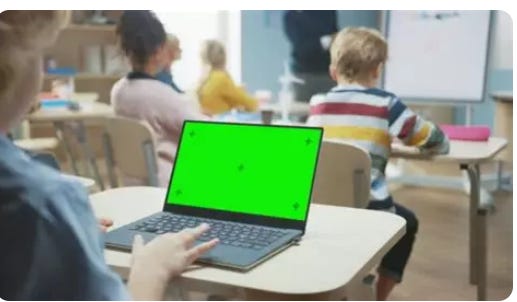
Most folks assumed that the 1-to-1 “learning device” practice would end once children returned to in-person learning, but having spent much of my journalism career on the education beat, I knew school districts don’t give up something if billions have been sunk into it, as was the case with gamified EdTech programs promising “enhanced” education.
I wish I’d been wrong but I wasn’t, and, due to a volunteer teaching position at my Catholic parish, I’ve had a front-row seat these past five years into the consequences of giving Big Tech’s drug of choice to little ones in the classroom.
I started teaching a 90-minute religious education class when my now-5th graders were in first grade. I’ve moved up with them every grade except fourth, so I have my own tiny sample to compare year-over-year. I’ve had 16 to 20 students, depending on the year, from five to seven different schools, both charter and public, so it’s a pretty broad sample.
When my students struggled with reading comprehension in first grade, I blamed it on being “COVID kinders,” the masks we still wore in first grade, and the fact that our parish used a Catholic school curriculum for religious education. In general, Catholic schools are about a year ahead of public schools in educational attainment, primarily due to a longer school day, required homework, mandatory parental involvement, and few — if any — special needs students.
But when the struggle was still present with my students in third grade, I couldn’t blame COVID and my concern moved to worry. One-third of my students struggled with reading fluency, and less than a quarter could answer a short-form question about what we’d read together aloud just 10 minutes prior.
This year, in 5th grade, worry became hyperventilation as I observed the inattention of most of the students (a problem well-documented by U.S. teachers) and the inability to read anything longer than a few paragraphs and remember it for a multiple-choice quiz given 15 minutes after our reading and discussion.
My blessed littles aren’t alone in this struggle with reading comprehension. The Chronicle of Higher Education reported last May that college professors can no longer assign long reading because students’ can’t handle it. Their attention has been destroyed by consumption of short-form content on their phones and the ‘infotainment’ passing as education via EdTech products.
Theresa MacPhail is a pragmatist. In her 15 years of teaching, as the number of students who complete their reading assignments has steadily declined, she has adapted. She began assigning fewer readings, then fewer still. … She would focus on the readings that mattered most and were interesting to them. For a while, that seemed to work. But then things started to take a turn for the worse. Most students still weren’t doing the reading. And when they were, more and more struggled to understand it. … She has long followed the mantra “meet your students where they are.” But she says if she meets them any further down, she’ll feel like a cruise director organizing games of shuffleboard. (Source: Is This The End of Reading?)
Dr. Horvath, from this column’s opening quote, has worked with schools across six continents studying the drop in IQ scores since the introduction of EdTech. His book, The Digital Delusion, focuses on how the human brain processes knowledge, how attention works, how information moves into long-term memory, and how screens interfere with all of that.
(Horvath’s research shows that) for nearly the entire 20th century, IQ scores rose steadily; each generation gained approximately six points over their parents, a phenomenon known as the Flynn Effect. Starting around the year 2000, this trend reversed across much of the Western world. Crucially, in countries where traditional schooling has remained largely intact, the decline has not occurred. … Over half of students now use computers for one to four hours daily in school; a full quarter spend more than four hours on screens during a typical seven-hour school day. And the evidence suggests that less than half of this screen time is spent on actual learning; students are off task for up to 38 minutes of every hour when using classroom devices. Far from the promised revolution, we appear to be witnessing an unprecedented experiment in cognitive attrition. (Source: Education Next
To be clear, the vast majority of screen use by children is outside of schools. Research shows that children ages 8 to 18 spend an average of 7 house per day on screens outside of school (video games, TV, tablets, phones, computers) and that rewiring of brains toward the addiction of reward has shortened attention spans and replaced a child’s natural curiosity with the urge for a dopamine hit. So, yes, parents are part of the problem.
But.
There’s also a difference between what screens are used for at home versus what they are used for at school. At home, it’s mostly for entertainment, so it doesn’t matter if Johnny remembers what the Wild Kratts did yesterday. Also, watching a show with a parent and talking about it is not the definition of ‘screen time’ medical experts are so worried about.
At school, students are using those screens in an attempt to learn, even though extensive research over decades has shown that reading comprehension — upon which all other learning is based — is damaged by reading on screens.
A 2024 meta-analysis of 49 studies found that students who read on paper consistently scored higher on comprehension tests than those who read the same material on screens. Researchers call this the “screen inferiority effect”—meaning that digital reading leads to lower information retention and understanding.
Moreover, because much of EdTech is gamified, students have lost the ability to wrestle to an answer. They are used to pushing this button on the screen and, if it’s wrong, getting another chance, and another, until they “win.” This isn’t learning. This is seeking the high of winning a game. It is monkeys at a typewriter trying to write Moby Dick.
So perhaps it’s unsurprising that some educators and parents are finally fighting back. In an New York Times’ essay last week titled “You Can’t Game Your Way to a Real Education,” history professor Molly Worthen argues that the “greatest blunder in the past decade of K-12 education” was the decision to pass out Chromebooks and to “gamify everything from standardized test preparation to recess.” (Yes, there are EdTech programs to mimic recess.) Like Horvath, Worthen has the receipts and isn’t afraid to use them:
The concept of a digital native is a myth. The advent of iPhones and laptops did not undo eons of brain evolution in the space of a few years — even if excessive screen time is associated with the thinning of the cerebral cortex. … Mistaken ideas about the nature of learning have combined with a hefty dose of Big Tech propaganda to distort our picture of what school is for. Technology must return to its proper place in the classroom — as a supplemental tool, rather than the source and summit of education. (Emphasis mine; NYT gift link to essay.)
Emily Cherkin is another person ringing the alarm. She is the lead plaintiff in a class-action lawsuit against PowerSchool, whose 2024 security breach affected millions of children/teachers and resulted in hackers demanding extortion payments from schools. She offers a free toolkit for parents to get their kids off devices at school and parents are using it, educating school board members, writing letters to the editor, politely informing teachers and administrators, “Thanks, but no thanks, no Chromebook/laptop for my child, I opt-in for the screen-free curriculum.”
Cherkin’s not alone in pushing back. The Los Angeles Board of Education voted this month to ban all screen use in kindergarten and first grade and limit it through 5th grade, directing administrators to to “guide teachers toward more paper and pen assignments.” As of this writing, 12 other states have introduced bills limiting screen time in schools.
Additionally, two California mothers are leading a class-action lawsuit against Curriculum Associates, who makes the i-Ready EdTech platform. The lawsuit alleges that the data profiles i-Ready creates on students to predict their behavior is monetized by Curriculum Associates and shared with third parties. If you read the legal filing, you will see that there are five pages — five pages — of data that Curriculum Associates gathers from every kid using the i-Ready platform.
You might think Cherkin et. al., are overreacting, but consider these statistics from Internet Safety Labs, a nonprofit product-safety testing and research organization that tests tech used in schools: Most apps used by K-12 students are unsafe and 75 % of EdTech applications expose children’s location, usage, and personally identifiable information to third parties without any consent.
Here I feel compelled to send a flare out for parents of babies and preschoolers: Some day cares have introduced using screens for recess, music, and even art with children as young as 2, so you might want to ask some questions.
Now, if using screens actually provided better education and produced better outcomes, we might accept reams of data on U.S. minors being vacuumed up by Big Tech. Risk v. Reward and all that.
But as Cherkin — not just a plaintiff, but a teacher, parent, and expert on wise screen-time use — writes on her Substack, EdTech products do not improve learning outcomes, are not safe for use by children, and aren’t superior to human teachers.
I’m not a luddite, despite what my adult children might think. I’m all for students learning about technology in schools, which is different than letting technology be responsible for their education.
I want to bring back technology education in a computer lab classroom, with a computer teacher and students learning keyboarding and coding, how to spot AI and misinformation/propaganda, and how to think about what Big Tech is doing in the world. I want critical thinking about technology in our lives, want students to know that every single day someone in Big Tech warns us about the huge risks of the generative AI (currently being pushed by the Trump administration to be launched in schools this fall), want students to know that many Big Tech billionaires send their kids to no-tech schools through 8th grade and write an essay on why that might be.
In other words, I want students smart enough to rule the robots that are coming, not students who’ve been so dumbed down by EdTech that they believe whatever an AI search engine tells them because they never learned — off screen — that AI search engines are wrong 60% of the time.
(And, for heavens sake, please realize I’m all for fully-developed adults using tech in schools to help with things like registering 1,200 high schoolers for classes. I’m not a heathen.)
If you hated what happened to your kid during COVID virtual learning, you might want to join the fight to move back to vetted, proven methods of teacher-student, paper-pencil, books-in-print education with computer labs in middle and high school to teach students about technology. Consider signing this petition to make sure generative AI isn’t introduced in schools. Read The Digital Delusion or Cherkin’s First Fish Chronicles Substack. Send the article What Happened After a Teacher Ditched Screens (here or here) to your child’s teacher, principal, and school board members. (Extra credit if you find the superintendent’s email and send him/her the article — or this column.) Pressure BigTech to be responsible because they know exactly what they are doing and parents can’t fight this alone.
Do your part to support schools by teaching your children that entertainment and learning are not the same thing; indeed, learning is really, really hard. Ban screens Monday through Thursday (and limit them on weekends), focusing instead on things that build brains and connection: reading 40 minutes solid, practicing musical instruments daily, playing that pick-up soccer game, doing chores, answering parental questions that normally get brushed off with “I don’t remember.” (It should go without saying, but of course it doesn’t because phones are addictive, but: Put your phone down too and pick up a book, go for a walk, host a party.)
“People are mistaking kids’ preference for deep biological reality. My daughter loves Popsicles. I have a choice: I could meet her where she’s at and start every meal with a Popsicle. But that doesn’t change the fact that, biologically, Popsicles aren’t good for her, and she needs some vegetables.” — Jared Horvath
I’ll leave you with this thought, which I’ve heard in various discussions about EdTech over the past month: When we teach children about drugs and alcohol in school, we do not do it by giving them drugs and alcohol at school. When we teach them about sex, we don’t do it by having them “try out” sex in the classroom.
So why would we hand them personal screens despite All. The. Evidence. that screens are dangerous/addictive for developing brains, that they interfere with learning, and that EdTech is making billions off students data and surveillance at schools?
As the kids say these days, “When you know better, you do better.” Let’s do that.
****
Apologies for this showing up on a Sunday evening instead of last Thursday morning, but heavens to Betsy, this was hard to report and write. Have the best week — and please share this column with parents in your lives.
YES, YES, YES. I could not agree more and I am so grateful to you for pulling this together.
Renee, you are spot on. As a 35 year teacher in Catholic schools, elementary through high school, I can attest to the decline you document…even before 2020. The curriculum I taught at one high school…years later had to be weakened for students at another high school. (2009-2016) The decline in Reading and writing is not just a result of COVID years. The steady decline because of the introduction and reliance on computers is staggering. Other countries have seen this and are banning computers in the classroom for younger students. Computers with high school students do not achieve the results that are hoped for.
Do our students need to know how to use technology? Absolutely, and you address this is your article.
Thank you for this informative article. I hope that those who,have the power to make change will do so and quickly. We only have our children in school for such a short time…we have no time to waste!